Driving License
Check driving license status and validity.
This tool takes a driving licence number and returns the record Sarathi holds for it - the holder's name, the licence status, the dates the non-transport and transport authorisations run to, and every class of vehicle the licence covers, split into non-transport and transport groups.
It also decodes the number itself into issuing state, RTO office and year of first issue, so an employer or platform can see at a glance whether the card they were shown matches the record and whether a transport endorsement is in force.
What is a driving licence?
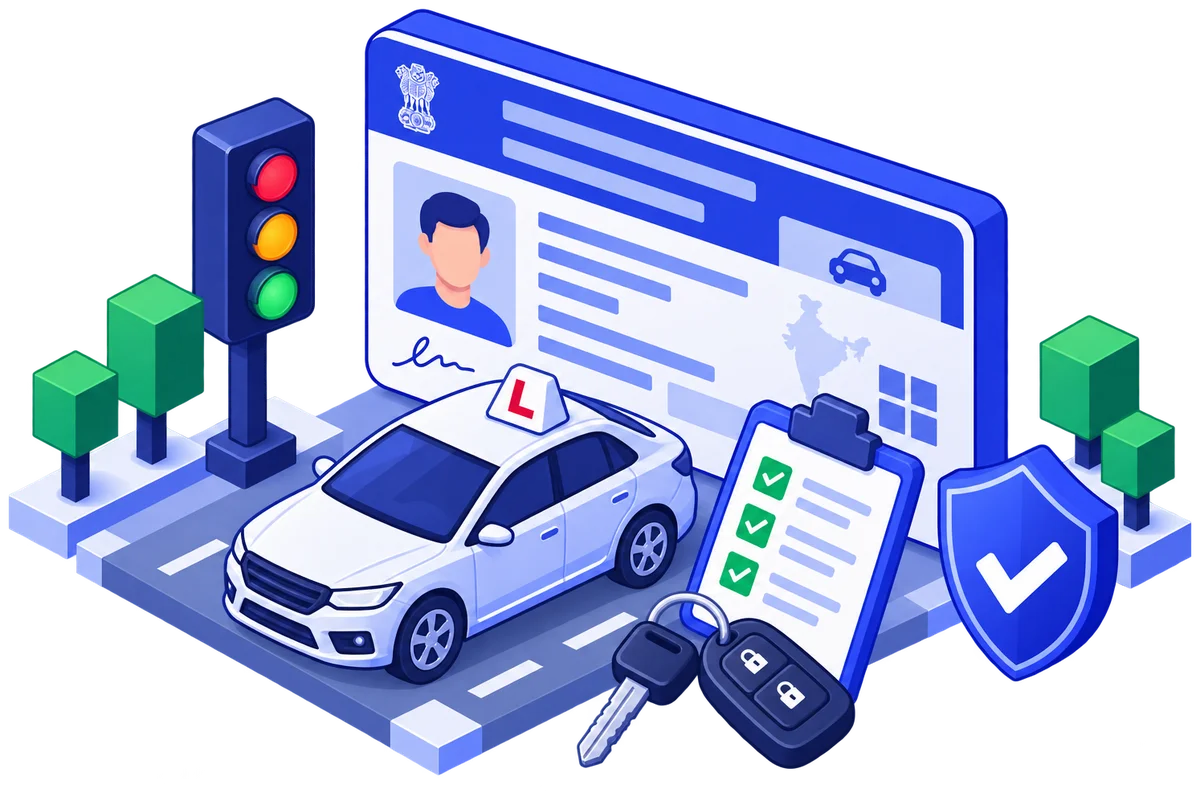
A driving licence (DL) is the authorisation under Section 3 of the Motor Vehicles Act, 1988 to drive specified classes of motor vehicle on a public road in India. It is granted by the licensing authority at a Regional Transport Office (RTO) and recorded in Sarathi, the national licence application built and hosted by the National Informatics Centre (NIC) for the Ministry of Road Transport and Highways (MoRTH). Sarathi is the licence half of Parivahan; Vahan is the vehicle half.
The Act and the Central Motor Vehicles Rules, 1989 (CMVR) set the sequence: a learner's licence (six months under Section 14(1)), a test of competence after 30 days, then the permanent licence as a Form 7 smart card. NIC rolled Sarathi out RTO by RTO from the mid-2000s (Tamil Nadu went live at Madurai North on 28 July 2007) and later merged the state databases into the centralised Sarathi 4.0, which is why some paper-era licences cannot be found online.
The Motor Vehicles (Amendment) Act, 2019, in force from 1 September 2019, rewrote the validity rules in Section 14 and the renewal window in Section 15. The Supreme Court's Constitution Bench in Bajaj Alliance General Insurance v Rambha Devi (6 November 2024) held that an LMV licence covers transport vehicles up to 7,500 kg gross vehicle weight, and on 30 March 2026 the Delhi High Court (Delhi Police v Sudheer Kumar) confirmed that the 2019 amendment removed the 30-day grace period: a licence is invalid from the day after expiry.
How Sarathi holds a licence record
Every licence is one record in the central Sarathi database, keyed by its DL number: two letters for the state, two digits for the RTO, four digits for the year of first issue and a seven-digit serial - fifteen characters, printed with a hyphen or space after the RTO code. Additions of class, renewals and endorsements are written against the same number, so the record reflects the current licence rather than the card in your wallet.
This tool reads that record through the Unified Logistics Interface Platform (ULIP), the DPIIT gateway that exposes Sarathi to authorised applications. Its SARATHI/02 endpoint returns the holder's name, the DL status, the two validity dates and the classes of vehicle (COV) - not date of birth, address or photograph - so the result verifies what a card claims rather than copying it.
- 1
Learner's licence
Form 2 plus an online test on road signs and rules; valid six months. Minimum age 18, or 16 for a motorcycle up to 50 cc, 20 for a transport vehicle (Section 4).
- 2
Test of competence
After 30 days on the learner's licence, the driving test at the RTO or an Accredited Driver Training Centre (CMVR rules 31B to 31J, from 1 July 2021). MoRTH clarified on 1 June 2024 that the ADTC certificate does not waive the RTO test.
- 3
Issue and record
The smart card is issued in Form 7 and the Sarathi record created with each class of vehicle and its non-transport or transport validity.
- 4
Additions and endorsements
New classes (₹500 per class) and the hazardous goods endorsement under CMVR rule 9 (a three-day course, licence effective three years) are added to the same record.
- 5
Renewal
Form 9, from one year before expiry to one year after: ₹200 in the window, ₹300 plus ₹1,000 per year or part-year of delay after it. Beyond one year a fresh test is required. A suspension or cancellation under Sections 19 to 22 is written to the same record.
How to check with Driving License
- 1
Enter the driving licence number
Type it as printed on the card, with or without hyphens and spaces - UP9620110001440 - into the Driving Licence Number field. The input is upper-cased and capped at 25 characters.
- 2
Check
The lookup sends the number to Sarathi through ULIP. A malformed number comes back as a field error; a well-formed number with no record shows "No driving licence record found".
- 3
Read the result
The headline card shows the licence holder, the status badge, the class count and a Transport endorsed badge. Below it sit the Non-transport validity and Transport validity tiles, the Classes of vehicle cards, the DL number anatomy card and the Record table. Use the toolbar to download the PDF or share the link.
Why check a driving licence
The card is not the record
A card can be forged, expired or show classes since removed. Sarathi holds the live status and dates; driving without a valid licence carries a fine of up to ₹5,000 under Section 181.
Transport work needs a transport class
Taxis, goods carriages and buses need LMV-TR, MGV, HGMV or HPMV, and transport validity runs only five years; a private LMV entry stops at 7,500 kg.
Insurance turns on it
A claim can be repudiated or recovered from the owner if the driver held no valid licence for that class on the day. Rambha Devi settled the LMV question, not expiry or suspension.
Expiry no longer has a buffer
Since 1 September 2019 there is no 30-day grace: a licence is invalid the day after the date on the tile, and renewal runs from the date it is granted.
Reading the result
The headline card, validity tiles and class cards are derived from the fields Sarathi returns; the Record table at the bottom shows the raw values before any colouring or date parsing.
- Licence holder
- The holder's full name as recorded in Sarathi. Compare it letter for letter with the card and the ID presented.
- Status
- The DL status from Sarathi. Active shows green; Expired, Cancelled, Revoked, Suspended or Surrendered show red; renewal or pending states show amber.
- Transport endorsed
- Shown when at least one class is a transport class (LMV-TR, TRANS, MGV, HGMV, HPMV, 3W-TR, e-rickshaw, e-cart). Absent means private vehicles only.
- Non-transport validity
- The date the non-transport authorisation runs to: green with more than 30 days left, amber inside 30 days, red once expired. Not licensed means the record has no non-transport date.
- Transport validity
- The date the transport authorisation runs to, same colours. Section 14 fixes it at five years (three for hazardous goods), so it usually expires first. Not licensed means no transport endorsement.
- Classes of vehicle
- One card per class, grouped under Non-transport and Transport. Each shows the code, a plain-language label and Sarathi's own description when it differs.
- MCWOG / MCWG
- Motorcycle without gear (scooters, mopeds) and motorcycle with gear. MCWG covers MCWOG vehicles too.
- LMV / LMV-NT / LMV-TR
- Light motor vehicle - cars, jeeps, vans up to 7,500 kg. NT is the private entry, TR the transport entry for a taxi or light goods carriage; some states print plain LMV for private use.
- HGMV / HPMV / HMV
- Heavy goods motor vehicle (over 12,000 kg), heavy passenger motor vehicle (buses) and the older combined heavy code; MGV and MPV are the medium equivalents.
- DL number anatomy
- The DL number split into State, RTO, Year and Serial, echoed as a decoded line under the DL number chip in the headline. Year is flagged unverified if it falls outside 1950 to next year.
Example input
UP9620110001440
Two-letter state code, two-digit RTO code, four-digit year of issue, seven-digit serial. Cards often print it as UP-9620110001440 or UP96 20110001440 - separators are ignored.
Who uses it
Driver hiring and fleet onboarding
Transporters confirm that a candidate's licence is active, that it carries the transport classes the job needs (LMV-TR, HGMV, HPMV) and that the transport validity has not lapsed.
Ride-hailing and delivery platforms
Onboarding teams match the submitted DL number against the holder name on record and check the non-transport or transport validity before activating an account.
Insurance claims and accident investigation
Insurers and investigators check whether the driver held a valid licence for that class of vehicle on the date of the incident.
Renewal planning
Holders check their own non-transport and transport dates so they can apply in the one-year window before expiry rather than after it.
Common problems
No driving licence record found for a genuine licence
Check the year block and leading zeros against the card. Paper licences issued before the RTO joined Sarathi may not be in the central database; the holder can ask the issuing RTO to migrate the record.
Number rejected as invalid
Sarathi rejected the format. Strip anything that is not a letter or digit and confirm it reads SSRRYYYYNNNNNNN; older layouts go in exactly as printed.
Status shows Active but the validity tile is red
Status and validity are separate fields and the status is not always updated at expiry. Treat the date as authoritative. Renew on Form 9 within one year of expiry to avoid a fresh test.
Transport validity says Not licensed for a driver who says they have a transport licence
The transport endorsement is a separate class with its own five-year date; either it was never added or it lapsed. Ask for the addition-of-class receipt and check again once the RTO updates the record.
Holder name differs from the ID presented
Sarathi stores the name as entered at issue. The holder can apply for a change of particulars (₹200) at any RTO in the state under Section 11 as amended in 2019, online with Aadhaar authentication since March 2021.
Frequently asked questions
Glossary
- Sarathi
- NIC's national licence application for MoRTH, covering learner's, driving and conductor licences.
- Parivahan
- The MoRTH portal fronting Sarathi (licences) and Vahan (vehicles); the digital licence in mParivahan or DigiLocker is valid under CMVR rule 139.
- COV
- Class of vehicle - the code for each type of vehicle the holder may drive, such as MCWG, LMV or HGMV.
- Non-transport
- Private classes. Since 1 September 2019: to age 40 if issued before 30, ten years if issued at 30 to 50, to age 60 if issued at 50 to 55, five years after 55. Earlier licences ran 20 years or to age 50.
- Transport
- Commercial classes - taxis, goods carriages, buses. Five years under Section 14(2)(a), three with a hazardous goods endorsement.
- Learner's licence
- The provisional licence, valid six months, that must be held for 30 days before the driving test.
- ADTC
- Accredited Driver Training Centre under CMVR rules 31B to 31J; its certificate supports the application but does not replace the RTO test.
- Form 9
- The CMVR renewal application. Form 2 is the learner's application, Form 4 the licence application, Form 7 the smart card itself.