MSME Lookup
Look up MSME/Udyam registration details by Udyam number.
This tool takes a Udyam Registration Number and returns what the Ministry of MSME's Udyam portal holds against it - the enterprise name, whether it is currently classed micro, small or medium, the owner, organisation type, registered address, every plant or unit location, and the NIC activity codes the enterprise declared.
It reads the live Udyam record through the Unified Logistics Interface Platform (ULIP), so the category shown is the one on file today, not the one printed on a certificate the vendor may have sent you months ago.
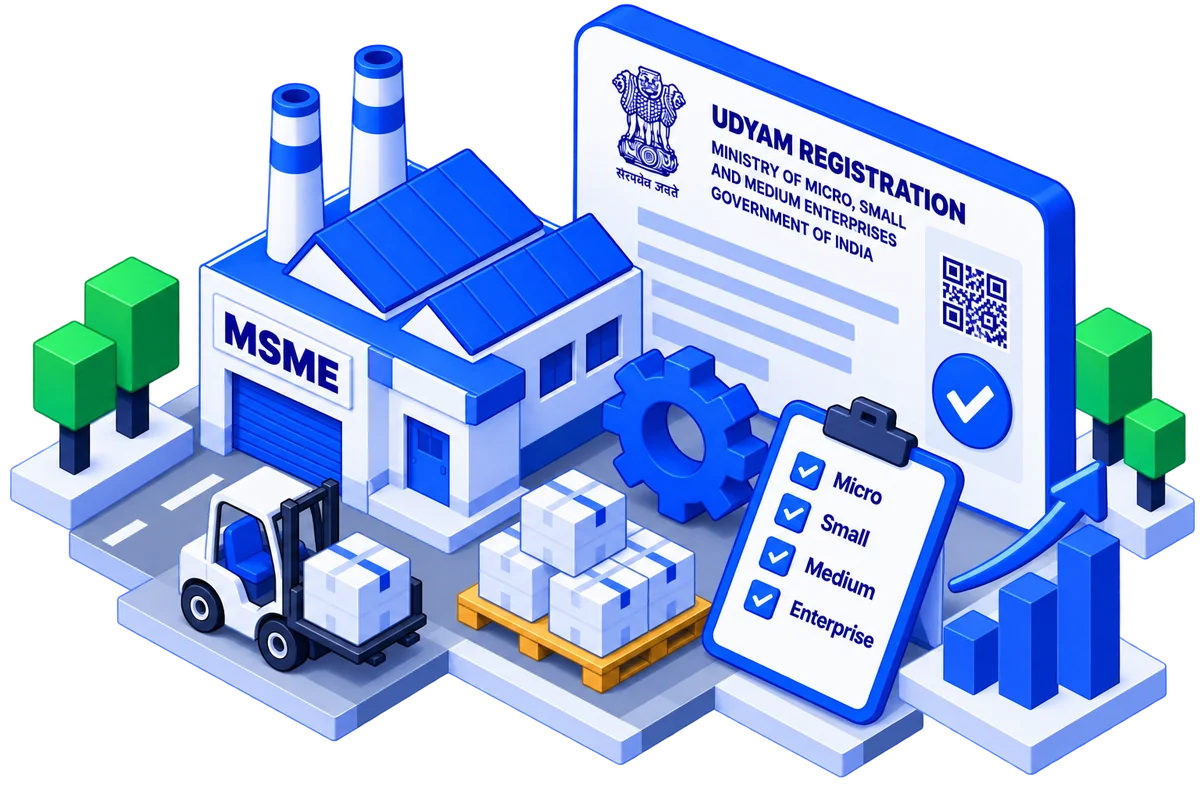
What is Udyam Registration?
Udyam Registration is the Government of India's registry of micro, small and medium enterprises (MSMEs), run by the Ministry of MSME at udyamregistration.gov.in - the memorandum an enterprise files under Section 8 of the MSMED Act, 2006. Filing is online, paperless, self-declared and carries no fee; it needs the Aadhaar of the proprietor, managing partner, karta or authorised signatory, the enterprise's PAN and, where the CGST Act requires one, its GSTIN. The portal allots a permanent Udyam Registration Number and an e-certificate with a dynamic QR code; there is no renewal.
Udyam replaced the Udyog Aadhaar Memorandum (UAM, from September 2015). Notification S.O. 2119(E) of 26 June 2020 brought it into force on 1 July 2020 with a composite definition: an enterprise is classed on both investment in plant and machinery or equipment and turnover, exports excluded. UAM holders had to re-register; UAM validity lapsed on 30 June 2022 (S.O. 2134(E), 6 May 2022). S.O. 1055(E) of 5 March 2021 limited the GSTIN requirement to enterprises that must register under GST, and an Office Memorandum of 2 July 2021 admitted retail and wholesale traders for priority sector lending only.
S.O. 1364(E) of 21 March 2025 raised the ceilings from 1 April 2025: micro up to ₹2.5 crore investment and ₹10 crore turnover, small ₹25 crore and ₹100 crore, medium ₹125 crore and ₹500 crore (previously ₹1/5, ₹10/50 and ₹50/250 crore). Since S.O. 4926(E) of 18 October 2022 an enterprise that graduates upward keeps its old non-tax benefits for three years. Informal micro enterprises without GSTIN can get an Udyam Assist Certificate through SIDBI's Udyam Assist Platform (launched 11 January 2023), at par with Udyam for priority sector lending under S.O. 1296(E) of 20 March 2023. As of 28 February 2026 the two platforms held over 7.83 crore registrations.
How the Udyam registry classifies an enterprise
An enterprise files once - the 2020 notification allows one Udyam Registration per enterprise, and all GSTINs under the same PAN count as one enterprise with aggregated figures. The portal does not take those figures on trust: investment in plant and machinery or equipment is drawn from income-tax returns (excluding land, building, furniture and fittings), and turnover and exports from the ITR and GST returns linked to the PAN and GSTIN. A new enterprise with no ITR self-declares until 31 March of the year it files its first return.
Because the data comes from tax filings, the category is recomputed each financial year. The rule is asymmetric: crossing either ceiling lifts the enterprise a category; it drops only when both figures fall below its current ceilings. Missing the annual update can lead to suspension, and misstatement is penalised under Section 27 of the MSMED Act. This tool shows the current portal state, fetched through ULIP's UDYAM/01 endpoint.
- 1
Aadhaar and PAN
The applicant authenticates with Aadhaar OTP; PAN and GSTIN are validated against the income-tax and GST databases.
- 2
Enterprise particulars
Name, organisation type, owner's social category and gender, office and plant addresses, employee counts, bank details and NIC 2008 activity codes are declared.
- 3
Number and certificate
The portal allots UDYAM-XX-00-0000000 - state code, district code, seven-digit serial - and issues the e-certificate with a QR code.
- 4
Annual recomputation
Investment and turnover for the previous financial year are read from ITR and GST data; the category is updated and any change is communicated.
- 5
Verification by third parties
Buyers, banks and platforms verify the number through the portal's Verify page, the QR code, or - as here - the ULIP integration that returns the record as data.
How to check with MSME Lookup
- 1
Enter the Udyam Registration Number
Type the 19-character number into the Udyam Registration Number field - UDYAM-AP-01-0019566. The field uppercases as you type; keep the hyphens.
- 2
Check
Press Check. The number is sent to the Udyam registry via ULIP; a malformed number is flagged under the field, an unknown one returns a No Udyam record found panel.
- 3
Read the record
The headline card shows the enterprise name, the Udyam number and a Micro, Small or Medium badge. Below it: Enterprise details, Registered address, one Plant location card per unit, and an Activities table with NIC 2-, 4- and 5-digit codes. Use Share to copy a link with the number pre-filled, or PDF for a report.
Why verify a Udyam number
The 45-day payment rule
Sections 15-16 of the MSMED Act oblige a buyer to pay a micro or small supplier within 45 days of acceptance (15 days if nothing is agreed) or owe compound interest at three times the RBI bank rate; since assessment year 2024-25, Section 43B(h) of the Income Tax Act also defers the buyer's deduction until payment. Whether a vendor is micro or small - not medium, not a trader - decides which invoices this covers.
Public procurement claims
The Public Procurement Policy for MSEs Order 2012 (mandatory from 1 April 2015) reserves 25 per cent of central procurement for micro and small enterprises (4 per cent SC/ST-owned, 3 per cent women-owned), waives tender fees and earnest money, and lets an MSE within L1 plus 15 per cent match L1 for up to 25 per cent of the order. Each claim rests on a valid Udyam record.
Priority sector and TReDS
Banks classify MSME credit as priority sector on a Udyam or Udyam Assist certificate, and companies above ₹250 crore turnover had to onboard TReDS by 31 March 2025. Both start with a check that the number is genuine and current.
Counterparty KYC
A Udyam record ties a trade name to a PAN-backed owner, a registered address and declared plants - a quick, official cross-check of what a counterparty claims before a contract or seller listing.
Reading the result
The headline card carries the identity; the cards below carry what the enterprise declared and what the portal holds. The Udyam feed does not expose investment or turnover figures - only the category they produce.
- Enterprise name
- The trade name as registered; the owner name is shown if the record has none.
- Micro / Small / Medium badge
- The category currently on file, computed from the last ITR and GST data under the ceilings in force since 1 April 2025. It can differ from an older printed certificate.
- Owner name
- The proprietor, managing partner, karta or authorised signatory whose Aadhaar was used to register.
- Organisation type
- Proprietary, partnership, HUF, company, LLP, cooperative, society or trust, as declared.
- Social category
- General, SC, ST or OBC as self-declared - the field behind the 4 per cent SC/ST procurement sub-target.
- Major activity
- Manufacturing, Services or Trading. Traders were admitted in July 2021 for priority sector lending only; Section 43B(h) does not extend to them.
- Incorporation date
- When the enterprise was set up. Production commenced shows the start date where the enterprise answered YES, otherwise the flag itself.
- Registration date
- When the Udyam record was created - for units migrated from Udyog Aadhaar, the migration date.
- Employees (M / F / Others)
- Male, female and other employee counts as declared; not verified against EPFO or ESIC.
- Registered address
- The office address assembled from flat, building, street, town, block, city, district, state and PIN.
- Plant location
- One card per unit: unit name, the old UAM number if carried over from Udyog Aadhaar, and the unit address.
- Activities
- Each declared activity with its NIC 2008 division (2-digit), class (4-digit) and sub-class (5-digit). One registration can list any number of activities.
Example input
UDYAM-AP-01-0019566
UDYAM, a two-letter state code, a two-digit district code and a seven-digit serial, separated by hyphens - 19 characters in all, as printed at the top of the Udyam certificate.
Who uses it
Vendor onboarding
Procurement teams confirm a supplier is a registered micro or small enterprise before tagging it for 45-day payment terms under the MSMED Act and Section 43B(h) of the Income Tax Act.
Tender and GeM eligibility
Buyers verify the Udyam category behind an EMD exemption or MSE price-preference claim, and check the NIC activity matches the goods or services being tendered.
Lending and PSL tagging
Banks and NBFCs check that a borrower's Udyam number is live and which category it falls in before classifying the loan under priority sector lending.
Logistics and platform KYC
Transporters, marketplaces and freight platforms verify the enterprise name and address behind a Udyam number during seller or shipper onboarding.
Common problems
The number looks right but the field says it is not valid
The registry accepts only UDYAM, two letters, two digits and seven digits with hyphens. Check for a letter O typed as zero, a missing hyphen or a trailing space. Udyog Aadhaar numbers (12 digits) cannot be looked up here.
No Udyam record found for a number on a certificate
A certificate from before 1 July 2020 is a UAM, which lapsed on 30 June 2022. A Udyam registration may also have been suspended for missing annual updates or cancelled. Ask the vendor to print the current certificate from udyamregistration.gov.in.
Category differs from the certificate the vendor sent
The portal recomputes the category every financial year, and the ceilings rose on 1 April 2025, so many enterprises moved down a category with no action of their own. Treat this tool's badge as current.
A buyer is not paying within 45 days
A micro or small enterprise with a valid Udyam number can file on MSME Samadhaan (samadhaan.msme.gov.in). The state's Micro and Small Enterprises Facilitation Council must decide within 90 days; interest runs at three times the RBI bank rate compounded monthly. Medium enterprises cannot use Samadhaan.
Details on the record are wrong or the owner cannot log in
Only the enterprise can edit its record, through Update / Cancel Udyam Registration on the portal with Aadhaar OTP. The Ministry's CHAMPIONS helpdesk answers at [email protected] and +91 8308809334 (Monday to Friday, 10 am to 6 pm); grievances go to champions.gov.in.
Frequently asked questions
Glossary
- MSMED Act, 2006
- The Micro, Small and Medium Enterprises Development Act - categories (Section 7), the registration memorandum (Section 8), delayed-payment rights (Sections 15-24), penalties (Section 27).
- Udyam Registration Number
- The permanent 19-character identity UDYAM-XX-00-0000000: state code, district code, seven-digit serial.
- Composite criterion
- Classification on both investment and turnover; exceeding either ceiling moves the enterprise up, falling below both moves it down.
- UAM
- Udyog Aadhaar Memorandum, the 12-digit registration used from September 2015 until 30 June 2022. Migrated units show it under Plant location.
- NIC 2008
- The National Industrial Classification maintained by MoSPI; Udyam records the division (2-digit), class (4-digit) and sub-class (5-digit).
- MSEFC
- Micro and Small Enterprises Facilitation Council - the state body under Section 18 that decides delayed-payment references from MSME Samadhaan.
- TReDS
- Trade Receivables Discounting System - RBI-regulated platforms (RXIL, M1xchange, Invoicemart) that finance MSME invoices; mandatory for buyers above ₹250 crore turnover since 31 March 2025.
- Udyam Assist Certificate
- Issued on SIDBI's Udyam Assist Platform to informal micro enterprises without GSTIN; equivalent to Udyam for priority sector lending.